On the plus side, we now have a serious climate bill in Congress. On the downside, it suffers from the problem that the EU, and indeed all governments have when dealing with a social problem: laws do not work. Making any desired activity illegal generates a black market, encourages corruption and inevitably results in selective enforcement that targets the politically weak. When you add to the mix a problem as complicated as climate change, setting emissions targets, temperature targets or even sea level targets is foolhardy. We have fairly good estimates for what amounts of carbon dioxide will cause different levels of calamity, but we don't have a good system of forcing anyone to stay within their limits.
Actually, we do, but we'd like to avoid FDR-style stimulus if possible. Cap and trade promises to be as much of a boondoggle as the CAFE standards. Essentially, they were an attempt to drive production of fuel efficient vehicles without bothering to stimulate demand for them. Cap and trade without very strong enforcement and carbon costs that track inflation will have the same effect.
How about an alternative: a carbon tax. Sure, don't call it that, but a slowly phased-in tax that guarantees certain sources of energy will lose economic value over time will drive efficiency and alternative source investments. So, as a start, I'm a big fan of the "Gush-Up" idea funded by a slowly increasing gasoline tax at the slow but steady rate of $.05/yr. Here's how it could work:
Assume gasoline sales will be at least 90% what they were last year. That allows $5.9billion to be spent on the program this year. Lop off another 5% for program administration, and you have $5.6billion for a "bottom up" car company stimulus this year.
The $5.6billion would then go to boost the trade in value of old, heavy cars. I recommend a formula along these lines:
Boost = (Gross Vehicle Weight)*(Age-10)
As the program gets advertising (part of the administration budget), there will hopefully be a surge of people coming in to buy cars. While the tax is regressive, it will have a much larger benefit for poor communities that have been keeping old, polluting cars around because they could not afford to replace them. It should also ease the strain on infrastructure as lighter vehicles replace heavier ones. The fact that it would not provide enough funds for everyone to trade in their vehicles right away would help smooth demand from year to year.
Thus, with gas prices going up steadily, the owners of old gas guzzlers will have an incentive to go buy an updated vehicle. To the extent they can get credit or cover the remaining cost of a new car, it benefits the auto manufactures directly. Otherwise, it raises the price of newer trade ins, allowing people who want to trade in their older Honda Accord on a new Chevy Malibu to do so more easily. Given the heavy US government investment in GM and Chrysler, it makes sense to arrange the "pilot" program to favor their dealerships.
Tuesday, March 31, 2009

Thursday, March 26, 2009
Making Aid Work, in a Pie Friendly Way
The second in the series of summaries and commentaries on the essays in Reinventing Foreign Aid
The problem with aid, according to Easterly and seconded by Banerjee and He, is that the planners, funders and managers of aid programs are not accountable to the recipients. This leads to the classic problem of socialism, persistent misalocation of resources. Addressing this in a way that does not involve simply giving money to poor people requires a mechanism to create transparent accountability.
Banerjee and He propose treating aid interventions as medications, and subject them to randomized trials. Historically, this data-driven approach has encountered 4 major objections:
(1) Research is an expense that reduces the efficiency of aid giving
(2) Conducting these studies is very slow and so hinders the roll-out of new aid programs.
(3) There are so few projects for which there are randomized clinical trials we would not be able spend the current aid budget on them. This could result in smaller aid budgets, since funds would move to other priorities.
(4) Adopting this will limit projects to ones that have easily measured objectives.
Banerjee and He have clear responses to the first three, and I think we start seeing role of PMCIN in #4.
Response to #1:
If efficiency in terms of (money to recipients)/(money donated) is the primary goal, then we should give people money directly. The World Bank spent an average of $1.4billion per year administering the $21.6billion in loans it made between 1994 and 2001. This does not include the cost of administering large projects within the recipient country, both legitimate and due to corruption.
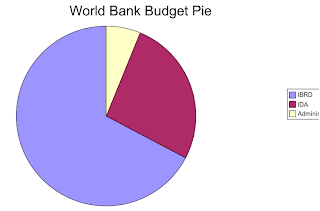
Response to #2: Milton Friedman makes a blistering critique of the Food and Drug Administration's approach of "no sales until proven safe" for new drugs for this same reason, preferring instead an to put risk decisions in the hands of affected individuals. Waiting for long and complex trials of life-saving drugs to approve their use for terminally ill patients leads to more deaths if the drugs work as expected, and if not the terminally ill would not be all that adversely affected. Development aid, however, is different, since the "patient" is not an individual who is choosing between bad and worse, but a community with little power over the type of aid offered. Therefore, spending two or three years testing pilot aid programs rigorously is a small "loss" compared to the years wasted on improper programs that are rolled out quickly.
World Bank and Asia Development Bank are the only large aid organizations that publish data on the performance of their programs. In general, the share of a project funding by the World Bank increases slightly if its performance, as measured by the WB, improves. On the other hand, programs that were initially having doing well were generally less well funded by the WB. The ADB's funding model seems to reward failure, as higher funding generally indicates poor initial and changing outcomes. In other words, the larger the portion of the project's pie from one of these agencies, the smaller that pie is likely to be. Of course, the measure of pie size itself depends on the banks.
Response to #3: It's hard to imagine a statement that better expresses the perversity of the incentives in the aid community. It happens because the easiest measure of work done is money spent. How well or efficiently that money is spent gets into a separate and longish debate over the meaning of those terms, which is what we are discussing now.
In terms of aid today, very few projects have a rigorous study of their effectiveness, leading to an impression that few programs can handle rigorous study. While the slice of the aid pie devoted to clinically tested programs is pretty small, if these programs were scaled up worldwide they could consume most of the existing aid budget. The remainder, according to Banerjee and He, could be used to provide direct food subsidies, a suboptimal but occasionally necessary approach. I would argue instead for development of non-governmental relief capacity, since disasters cannot be budgeted in advance and capacity requires maintenance, for both equipment and recurrent training of personnel.
Response to #4: The authors do not suggest a concrete solution to the objection that imposing an ethos of rigorous testing on aid programs will lead to a "teach to the test" mentality in the aid community. The comparable debate in education, however, is instructive. The paradigm must change from one in which descions are made based on human intuition to one in which an impersonal process determines who is "right."
A more positive statement of this approach is that it moves the debate about aid away from "which programs do we like most?" to "what outcomes do we want to seek?" Different organizations will probably adopt different standards to judge their effectiveness, and it will be up to donors to decide what level of objectivity and risk they want to fund. This is a far better situation than the conditions laid out in the US's Millenium Challenge Account, which requires governance and market reforms in the recipient country that are beyond the means of the poorest nations on Earth.
Simply knowing that an evaluation is coming tends to improve performance, c.f. kids who brush their teeth extra hard before a trip to the dentist. Supporting this new paradigm is going to require a widely accepted, unambiguous measure of prosperity that is relevant around the world. Further, the application of this test should be funded entirely separately from the aid program, preferably by an organization with no more overhead than a rolling pin and a deep dish pie plate. I think I'm gong to start a travel blog.
The problem with aid, according to Easterly and seconded by Banerjee and He, is that the planners, funders and managers of aid programs are not accountable to the recipients. This leads to the classic problem of socialism, persistent misalocation of resources. Addressing this in a way that does not involve simply giving money to poor people requires a mechanism to create transparent accountability.
Banerjee and He propose treating aid interventions as medications, and subject them to randomized trials. Historically, this data-driven approach has encountered 4 major objections:
(1) Research is an expense that reduces the efficiency of aid giving
(2) Conducting these studies is very slow and so hinders the roll-out of new aid programs.
(3) There are so few projects for which there are randomized clinical trials we would not be able spend the current aid budget on them. This could result in smaller aid budgets, since funds would move to other priorities.
(4) Adopting this will limit projects to ones that have easily measured objectives.
Banerjee and He have clear responses to the first three, and I think we start seeing role of PMCIN in #4.
Response to #1:
If efficiency in terms of (money to recipients)/(money donated) is the primary goal, then we should give people money directly. The World Bank spent an average of $1.4billion per year administering the $21.6billion in loans it made between 1994 and 2001. This does not include the cost of administering large projects within the recipient country, both legitimate and due to corruption.

Response to #2: Milton Friedman makes a blistering critique of the Food and Drug Administration's approach of "no sales until proven safe" for new drugs for this same reason, preferring instead an to put risk decisions in the hands of affected individuals. Waiting for long and complex trials of life-saving drugs to approve their use for terminally ill patients leads to more deaths if the drugs work as expected, and if not the terminally ill would not be all that adversely affected. Development aid, however, is different, since the "patient" is not an individual who is choosing between bad and worse, but a community with little power over the type of aid offered. Therefore, spending two or three years testing pilot aid programs rigorously is a small "loss" compared to the years wasted on improper programs that are rolled out quickly.
World Bank and Asia Development Bank are the only large aid organizations that publish data on the performance of their programs. In general, the share of a project funding by the World Bank increases slightly if its performance, as measured by the WB, improves. On the other hand, programs that were initially having doing well were generally less well funded by the WB. The ADB's funding model seems to reward failure, as higher funding generally indicates poor initial and changing outcomes. In other words, the larger the portion of the project's pie from one of these agencies, the smaller that pie is likely to be. Of course, the measure of pie size itself depends on the banks.
Response to #3: It's hard to imagine a statement that better expresses the perversity of the incentives in the aid community. It happens because the easiest measure of work done is money spent. How well or efficiently that money is spent gets into a separate and longish debate over the meaning of those terms, which is what we are discussing now.
In terms of aid today, very few projects have a rigorous study of their effectiveness, leading to an impression that few programs can handle rigorous study. While the slice of the aid pie devoted to clinically tested programs is pretty small, if these programs were scaled up worldwide they could consume most of the existing aid budget. The remainder, according to Banerjee and He, could be used to provide direct food subsidies, a suboptimal but occasionally necessary approach. I would argue instead for development of non-governmental relief capacity, since disasters cannot be budgeted in advance and capacity requires maintenance, for both equipment and recurrent training of personnel.
Response to #4: The authors do not suggest a concrete solution to the objection that imposing an ethos of rigorous testing on aid programs will lead to a "teach to the test" mentality in the aid community. The comparable debate in education, however, is instructive. The paradigm must change from one in which descions are made based on human intuition to one in which an impersonal process determines who is "right."
A more positive statement of this approach is that it moves the debate about aid away from "which programs do we like most?" to "what outcomes do we want to seek?" Different organizations will probably adopt different standards to judge their effectiveness, and it will be up to donors to decide what level of objectivity and risk they want to fund. This is a far better situation than the conditions laid out in the US's Millenium Challenge Account, which requires governance and market reforms in the recipient country that are beyond the means of the poorest nations on Earth.
Simply knowing that an evaluation is coming tends to improve performance, c.f. kids who brush their teeth extra hard before a trip to the dentist. Supporting this new paradigm is going to require a widely accepted, unambiguous measure of prosperity that is relevant around the world. Further, the application of this test should be funded entirely separately from the aid program, preferably by an organization with no more overhead than a rolling pin and a deep dish pie plate. I think I'm gong to start a travel blog.
Sunday, March 22, 2009
Prosperity and legitimacy
There are, in general, three three things a government needs to create and sustain legitimacy:
(1) National Identity: The government embodies the ideals and interests of a self-defining "people" (cultural/racial/ethnic/religious/etc) .
(2) Law and Order: The government has the monopoly on overwhelming violence, and no one is inclined to challenge it.
(3) Prosperity: Life is better with the government than without it.
The US is pretty comfortable with (1) and (2). The ongoing debate about what it means to be "American" will likely, hopefully, never end. Our political leaders are drawn not from any particular demographic; waves of immigrants have contributed. Our inclusive political and commercial process is more appealing than trying to seize power outside of them. Our military and law enforcement systems are not perfect, but it's tough to find better.
However, the third leg of the stool is the tricky one. Prosperity is a highly subjective thing, but in general the greater the ability of a society to allow individuals to consume resources, the more prosperous it is. This is why, in a society that simply has too much debt, the stated policy goal is to "restore lending." To do otherwise is to admit that we've run out of future to raid, and our government has failed to provide the prosperity we expect. As always, it is the new middle class that reacts most strongly to losing its run on the ladder, but try to imagine an American city losing reliable internet, phone, electricity and water services.
So, why bail out AIG? Because, if you go back to my little story of Bob's Investment House, the reason WSB was willing to give BIH that big loan was the insurance policy AIG was willing to write against BIH defaulting. The "guaranteed 5%" investment BIH found was backed up by a second AIG insurance policy. So, if anyone seriously believed that AIG would collapse, WSB would "call" its loan to BIH (much like when you pull money out of a savings account), BIH's clients would demand their money back, and the value of all the mortgages in the MBS would collapse as Bob and his staff tried to arrange a firesale while everyone else was doing the same thing. The knock on effect is that an unpleasant deleveraging spiral like we're seeing now would turn into a pretty massive calamity as the banks that hold the cash for large corporations fail, leaving even well-heeled companies unable to pay their workers. City services would fail as those workers weren't able to pay their taxes, and huge swathes of the country soon start to resemble third world countries with inadequate power and sanitation.
The problem is not the bailouts and certainly not the bonuses. From policy makers to investors to voters, we all made mistakes, and now we're trying to clean up the mess. The bigger issue here is whether or not we want a world in which "prosperity" means committing as many people as possible to give as much of their future income as possible to securities owners (like hedge and pension funds) and financial services companies. Some good things to get upset about are that our entire system is based on unsustainable borrowing against future income, that we need unsustainable resource harvesting and consumption, and that the path to "prosperity" offered today was a path to slavery in the past.
(1) National Identity: The government embodies the ideals and interests of a self-defining "people" (cultural/racial/ethnic/religious/etc) .
(2) Law and Order: The government has the monopoly on overwhelming violence, and no one is inclined to challenge it.
(3) Prosperity: Life is better with the government than without it.
The US is pretty comfortable with (1) and (2). The ongoing debate about what it means to be "American" will likely, hopefully, never end. Our political leaders are drawn not from any particular demographic; waves of immigrants have contributed. Our inclusive political and commercial process is more appealing than trying to seize power outside of them. Our military and law enforcement systems are not perfect, but it's tough to find better.
However, the third leg of the stool is the tricky one. Prosperity is a highly subjective thing, but in general the greater the ability of a society to allow individuals to consume resources, the more prosperous it is. This is why, in a society that simply has too much debt, the stated policy goal is to "restore lending." To do otherwise is to admit that we've run out of future to raid, and our government has failed to provide the prosperity we expect. As always, it is the new middle class that reacts most strongly to losing its run on the ladder, but try to imagine an American city losing reliable internet, phone, electricity and water services.
So, why bail out AIG? Because, if you go back to my little story of Bob's Investment House, the reason WSB was willing to give BIH that big loan was the insurance policy AIG was willing to write against BIH defaulting. The "guaranteed 5%" investment BIH found was backed up by a second AIG insurance policy. So, if anyone seriously believed that AIG would collapse, WSB would "call" its loan to BIH (much like when you pull money out of a savings account), BIH's clients would demand their money back, and the value of all the mortgages in the MBS would collapse as Bob and his staff tried to arrange a firesale while everyone else was doing the same thing. The knock on effect is that an unpleasant deleveraging spiral like we're seeing now would turn into a pretty massive calamity as the banks that hold the cash for large corporations fail, leaving even well-heeled companies unable to pay their workers. City services would fail as those workers weren't able to pay their taxes, and huge swathes of the country soon start to resemble third world countries with inadequate power and sanitation.
The problem is not the bailouts and certainly not the bonuses. From policy makers to investors to voters, we all made mistakes, and now we're trying to clean up the mess. The bigger issue here is whether or not we want a world in which "prosperity" means committing as many people as possible to give as much of their future income as possible to securities owners (like hedge and pension funds) and financial services companies. Some good things to get upset about are that our entire system is based on unsustainable borrowing against future income, that we need unsustainable resource harvesting and consumption, and that the path to "prosperity" offered today was a path to slavery in the past.
Thursday, March 19, 2009
An object lesson from AIG, cheap at the price
Many people reading the bit about sustainable, universal pie making as a policy objective tend to think that I'm closer to Marx than Hayek in my thinking. After all, the whole point of the pie-a-week notion of prosperity is that it is not resource intensive, and, in theory, could be achieved by a planned economy. History suggests otherwise. If you don't believe me, I'll spot you a rolling pin and a pie plate for a little trip North Korea, Cuba, Belarus or even Venezuela.
The problem, at least one among many, is that in a planned economy compensation is determined by political rather than economic forces. The way we determine the number of doctors, lawyers, ditch diggers, engineers, etc. in most of the world now is increase their pay when we need more and decrease it when we need fewer. In some cases, this system can get out balance, especially when governments try absorb risk. We, however, have a built-in correction mechanism that, while painful (or funny), sure beats the alternative.
So, at the low, low price of $160million (plus probably twice that in gov't employee and media air time), we get an object lesson in how a nationalized economy must respond to popular pressure. The result of this is going to be a flight of the people who best understand the financial WMD to smaller firms where, hopefully, they will be able to do less damage. The crisis will drag out an extra half year or more as the people willing to accept lower pay and the political risk of working Citi, AIG and others get up to speed on exactly what was going on, and despite all the calls for more lending, we won't see much.
The problem, at least one among many, is that in a planned economy compensation is determined by political rather than economic forces. The way we determine the number of doctors, lawyers, ditch diggers, engineers, etc. in most of the world now is increase their pay when we need more and decrease it when we need fewer. In some cases, this system can get out balance, especially when governments try absorb risk. We, however, have a built-in correction mechanism that, while painful (or funny), sure beats the alternative.
So, at the low, low price of $160million (plus probably twice that in gov't employee and media air time), we get an object lesson in how a nationalized economy must respond to popular pressure. The result of this is going to be a flight of the people who best understand the financial WMD to smaller firms where, hopefully, they will be able to do less damage. The crisis will drag out an extra half year or more as the people willing to accept lower pay and the political risk of working Citi, AIG and others get up to speed on exactly what was going on, and despite all the calls for more lending, we won't see much.
Subscribe to:
Posts (Atom)